Introduction: Why Fitness Accessories Matter for Home Workouts
The home fitness revolution isn’t slowing down—it’s evolving. While massive multi-gyms grab headlines, the real game-changers are the accessories that transform any living space into a functional training environment. The home gym equipment market is projected to reach $28.57 billion by 2033, and accessories represent the fastest-growing segment within that explosion.
Here’s what most people get wrong: they think home gym equipment means dropping thousands on bulky machines. The truth? A strategic collection of fitness accessories—dumbbells, resistance bands, yoga mats, kettlebells—delivers more workout versatility per square foot than any single piece of exercise equipment. These tools adapt to your fitness level, work across multiple training styles, and cost a fraction of traditional gym memberships.
Whether you’re establishing your first workout setup at home or upgrading an existing space, the right accessories multiply your training options without multiplying clutter. This guide breaks down fifteen essential pieces that punch above their weight class—literally and figuratively.
1. Dumbbells: Versatile Home Gym Equipment Essentials
Dumbbells remain the cornerstone of any serious home workout setup—and for good reason. As the home gym equipment market continues its explosive growth, dumbbells consistently top sales charts because they deliver progressive overload without the progressive price tag of complex machines.
What makes dumbbells indispensable? Their ability to isolate muscle groups while engaging stabilizers creates functional strength that translates to real-world movements. Unlike fixed-path machines, free weights force your body to balance, and control the load through natural ranges of motion. You’re not just building muscle—you’re building coordination and joint stability. The beauty lies in their scalability. A beginner can master basic bicep curls and shoulder presses with light weights, while advanced lifters can push heavy compound movements. This adaptability explains why home gym equipment purchases increasingly favor versatile tools over single-purpose gadgets.
For space-conscious fitness enthusiasts, adjustable dumbbells that consolidate multiple weight ranges solve the storage dilemma elegantly. One pair replaces an entire rack, transforming a corner of your bedroom into a legitimate training zone. Whether you’re targeting muscle hypertrophy, endurance, or strength, dumbbells form the foundation that makes everything else optional rather than essential.
2. Resistance Bands: Affordable and Portable Fitness Equipment
When space is tight and budgets are tighter, resistance bands emerge as one of the best fitness accessories for home workouts can rely on. These elastic powerhouses pack serious muscle-building potential into a form factor that fits in a drawer—no small feat for equipment that can replace an entire rack of dumbbells.
What makes them indispensable? Resistance bands offer progressive tension throughout every movement, creating constant muscle engagement that free weights can’t always match. A 2026 market analysis from Civic Science shows resistance training accessories have become the second-most purchased home fitness category, right behind cardiovascular equipment.
The practical advantages multiply quickly. Travel-friendly? Absolutely—loop bands weigh ounces and fold into carry-on luggage. Joint-friendly? They provide accommodating resistance that feels smoother on connective tissue compared to heavy iron. Budget-friendly? A complete set costs less than a single month’s gym membership while delivering comparable resistance levels from 5 to 150+ pounds.
However, not all bands are created equal. Looped resistance bands offer the most versatility for lower-body work, mobility drills, and while tube bands with handles excel at mimicking traditional strength exercises. The key is matching band thickness and tension to your current strength level—most sets include color-coded options for progressive overload. One practical approach is pairing bands with other basic home gym equipment to create compound movements that challenge multiple muscle groups simultaneously, maximizing workout efficiency in minimal square footage.
3. Yoga Mat: The Foundation of Comfortable Workouts
Before you invest in flashy home workout equipment, start with what literally grounds every movement: a quality yoga mat. This deceptively simple accessory transforms hard floors into cushioned workout zones—whether you’re flowing through vinyasas, crushing HIIT circuits, or stretching after strength training.
The right mat does more than prevent slipping. It protects joints during floor exercises, defines your workout space mentally (a crucial boundary when your living room doubles as your gym), and rolls up in seconds for storage. Thickness matters here—6mm offers the sweet spot between cushioning, stability for most exercises, and while 3-4mm works better for balance-focused practices. Today’s mats range from basic PVC options under $20 to eco-friendly cork and natural rubber versions approaching $100. The difference shows in durability and grip performance when you’re sweating. Closed-cell construction prevents moisture absorption, keeping bacteria at bay during those intense sessions.
One practical marker of quality: a mat that stays put without corner curling. Cheaper mats slide around or develop memory creases, disrupting flow mid-workout. Look for non-slip textures on both sides if you’re working on smooth flooring.
With yoga participation continuing its upward trend, investing in proper foundational gear makes sense. Your mat becomes the launchpad for nearly every floor-based movement—making it arguably more essential than most equipment promising dramatic results.
4. Jump Rope: Cardio That Fits in Your Pocket
While professional fitness accessories for home often command premium prices, the jump rope proves that effective cardio doesn’t require a hefty investment. This childhood staple delivers Olympic-athlete-level cardiovascular training for less than the cost of a single boutique fitness class.
The numbers speak volumes: ten minutes of rope jumping burns roughly the same calories as thirty minutes of jogging, making it one of the most time-efficient workouts available. You’re engaging your calves, shoulders, core, and coordination simultaneously—a full-body workout compressed into whatever space you can swing your arms.
Modern jump ropes have evolved beyond basic playground equipment. Weighted handles add resistance training to cardio work, while adjustable lengths accommodate users from five feet to well over six. Speed ropes with ball-bearing systems let you build up to double-unders and advanced techniques that challenge even seasoned athletes.
The portability factor is unmatched. Toss it in a suitcase, backpack, or desk drawer. Hotel room too cramped? Most parking lots provide enough space for a quick cardio session. This accessibility explains why jump ropes remain a staple among smart fitness enthusiasts who value efficiency alongside their other home investments.
The learning curve matters here. Expect some ankle-whacking initially, but most people develop basic proficiency within a week. Start with 30-second intervals, gradually building endurance as your rhythm improves. Before long, you’ll understand why boxers have relied on this simple tool for decades—it transforms cardiovascular capacity faster than almost any other single piece of exercise equipment.
5. Weight Bench: Expanding Strength Training Options
A strength training equipment transforms your home workout from basic to comprehensive. While dumbbells alone offer plenty of movement options, a bench unlocks an entirely different category of exercises—chest presses, incline movements, supported rows, and step-ups suddenly become part of your routine. The beauty here is versatility without complexity. A flat bench handles most needs, but adjustable models let you target muscles from multiple angles. According to market analysis, strength training equipment continues gaining popularity as more people build dedicated workout spaces at home.
Look for benches rated for at least 500 pounds to ensure stability during dynamic movements. The frame should feel solid when you sit on it—any wobble indicates weak construction. Padding matters too; cheap foam compresses quickly and becomes uncomfortable, while quality vinyl-covered cushioning holds its shape through years of use.
One often-overlooked benefit: a sturdy bench doubles as seating for other exercises. Bulgarian split squats, tricep dips, and box jumps all become possible. If you’ve already invested in adjustable dumbbells, a bench is the logical next step to maximize their utility.
Example Scenarios: How These Accessories Enhance Home Workouts
A beginner starting their fitness journey might invest in resistance bands and a jump rope—spending roughly $40 total. Within weeks, they’re completing full-body circuits that rival the variety offered by a multi-gym setup costing thousands more. The bands handle strength training, while the rope delivers cardiovascular intensity.
For intermediate lifters working from home, the combination of adjustable dumbbells and a strength training equipment creates surprising versatility. A typical upper-body session might include bench presses, rows, shoulder presses, and flys—movements that traditionally require multiple fixed-weight sets. According to market analysis, this adaptability drives purchasing decisions for 68% of home gym builders. What often happens is this: someone buys a single piece of quality equipment, then gradually adds complementary accessories. The yoga mat purchased for stretching becomes the foundation for core work. The resistance bands bought for travel become essential for warm-ups and muscle activation. Each addition compounds the effectiveness of what’s already there, creating a system greater than the sum of its parts.
Limitations and Considerations
Despite the clear advantages of home home gym equipment, several practical limitations deserve attention. Space constraints rank as the most common challenge—even compact accessories accumulate quickly. A yoga mat, resistance bands, dumbbells, and a jump rope might seem minimal individually, but collectively they require dedicated storage to avoid cluttering living spaces.
Budget misconceptions also trip up beginners. While you can find cheap workout equipment for home options for under $20, building a comprehensive setup costs more than many anticipate. That $15 resistance band set might work initially, but serious strength progression typically requires upgrading to heavier dumbbells or more varied equipment within 3-6 months.
Quality varies dramatically across price points. A $10 yoga mat deteriorates faster than a $40 version, and bargain-bin resistance bands often snap mid-exercise. What appears economical initially becomes expensive when replacements become necessary.
Motivation without structure presents another hurdle. Commercial gyms provide environmental cues and social accountability that home workouts lack. Without scheduled classes or training partners, consistency becomes challenging for many people—evidenced by the dusty home workout equipment filling countless basements and spare rooms.
Finally, technique matters more without supervision. Improper form with resistance training equipment can cause injury, particularly as weights increase. Self-taught exercisers benefit from video tutorials or occasional professional guidance to establish proper movement patterns before building serious strength.
Future Implications: What’s Next for Home Fitness Accessories
The home gym equipment market is projected to reach $28.57 billion by 2033, signaling massive shifts ahead for accessories and training tools. Smart integration is becoming non-negotiable—traditional equipment like the strength training equipment is evolving with built-in sensors that track form, rep count, and muscle engagement in real-time. Expect three major trends to reshape home fitness:
AI-Powered Form Correction: Future accessories will use computer vision to analyze movement patterns and provide instant feedback. What currently requires a personal trainer will soon come standard with resistance bands and bodyweight tools.
Modular, Space-Adaptive Design: Manufacturers are developing accessories that transform based on workout type—a single platform might function as a step bench, plyo box, and balance trainer through simple mechanical adjustments.
Biometric Integration: Smart tracking devices are just the beginning. Coming accessories will sync heart rate variability, muscle oxygen levels, and recovery metrics directly to training apps, creating truly personalized workout programming.
The line between home and commercial-grade equipment continues to blur. Within five years, the accessories sitting in your spare room may offer the same data-driven insights currently available only at elite training facilities.
Key Home Gym Equipment Takeaways
Investing in the right cool fitness accessories for home setups requires balancing your specific goals with practical constraints like space, budget, and long-term commitment. Start with versatile foundations—resistance bands, adjustable dumbbells, and stability balls deliver maximum return on minimal investment while adapting to various workout styles. Smart purchasing matters more than quantity. The home fitness market’s projected growth to $28.57 billion by 2033 reflects increased consumer sophistication, not just enthusiasm. Focus on equipment that serves multiple functions and matches your actual workout patterns rather than aspirational routines you won’t maintain.
Space efficiency determines long-term success. Collapsible benches, door-mounted pull-up bars, and wall-anchored systems preserve living areas while maintaining workout intensity. Quality over quantity applies especially to smaller spaces—one premium adjustable dumbbell set beats a dozen single-weight pairs cluttering your floor.
Budget accessibility doesn’t require compromise. Strategic purchases under $100—foam rollers, yoga mats, kettlebells—build comprehensive capabilities without financial stress. The key insight: effective home fitness stems from consistent use of basic equipment, not accumulation of advanced machinery that becomes expensive storage.
What’s Your Favorite Fitness Purchases Under $100?
Building an effective home workout space doesn’t require breaking the bank. Some of the most versatile strength training equipment options fall well within a modest budget while delivering outsized returns on investment.
Resistance bands consistently top the value list, offering progressive tension from 10 to 150+ pounds for $15-40. They pack flat for travel, attach to door anchors for unlimited exercise variations, and provide joint-friendly resistance that mirrors cable machines costing thousands.
Adjustable dumbbells in the 20-50 pound range ($60-95) eliminate the rack sprawl of fixed-weight sets while covering most upper body and core exercises. A single pair replaces 10+ individual dumbbells, making them ideal for compact spaces.
Foam rollers and massage balls ($12-35) address the recovery side that many beginners overlook. Self-myofascial release reduces soreness, improves range of motion, and extends the lifespan of more intensive training. A lacrosse ball costs $3 but reaches trigger points no therapist’s hands can access.
Ab wheels ($15-25) humble even experienced athletes while building genuine core strength—not just surface aesthetics. The stability demand translates directly to better performance in compound lifts and everyday movement.
Jump ropes have evolved beyond playground basics. Speed ropes with ball-bearing swivels ($20-40) deliver cardiovascular conditioning that rivals treadmills, burning 10-15 calories per minute while improving coordination and foot speed.
One practical approach is investing in quality over quantity—a $60 premium kettlebell outlasts three cheap versions while maintaining resale value when upgrading to heavier weights.
Home Gym Setups – What Works? What Doesn’t?
The most successful home gym configurations share a common trait: they maximize versatility while minimizing wasted space. Adjustable components consistently outperform single-purpose equipment in long-term value and usage rates.
What Works:
- Compact multi-function stations that combine pull-up bars, dip stations, and resistance band anchors in one footprint
- Foldable benches and racks that tuck against walls when not in use
- Mirror-based systems that eliminate the need for bulky equipment while providing guided workouts
- Modular storage solutions that keep smaller accessories organized and accessible
What Doesn’t:
- Oversized cardio machines that dominate square footage – they typically become expensive clothing racks within six months
- Single-weight sets instead of adjustable options that adapt as you progress
- Trendy equipment without long-term workout applications (think ab rollers gathering dust)
- Poor flooring choices that damage easily or provide
- inadequate cushioning
A practical pattern emerges: equipment that adapts to multiple exercises
- fitness levels gets used consistently
- while specialized gear collects dust. The sweet spot lies in selecting three to four versatile pieces that cover strength, cardio, and flexibility work without cluttering your space.
What Are Some Good Fitness Equipment to Buy for Home?
The smartest equipment purchases balance versatility, space efficiency, and long-term value. What typically happens is that successful home gym builders start with foundational pieces that enable multiple workout styles rather than specialized single-purpose machines.
Essential Core Equipment:
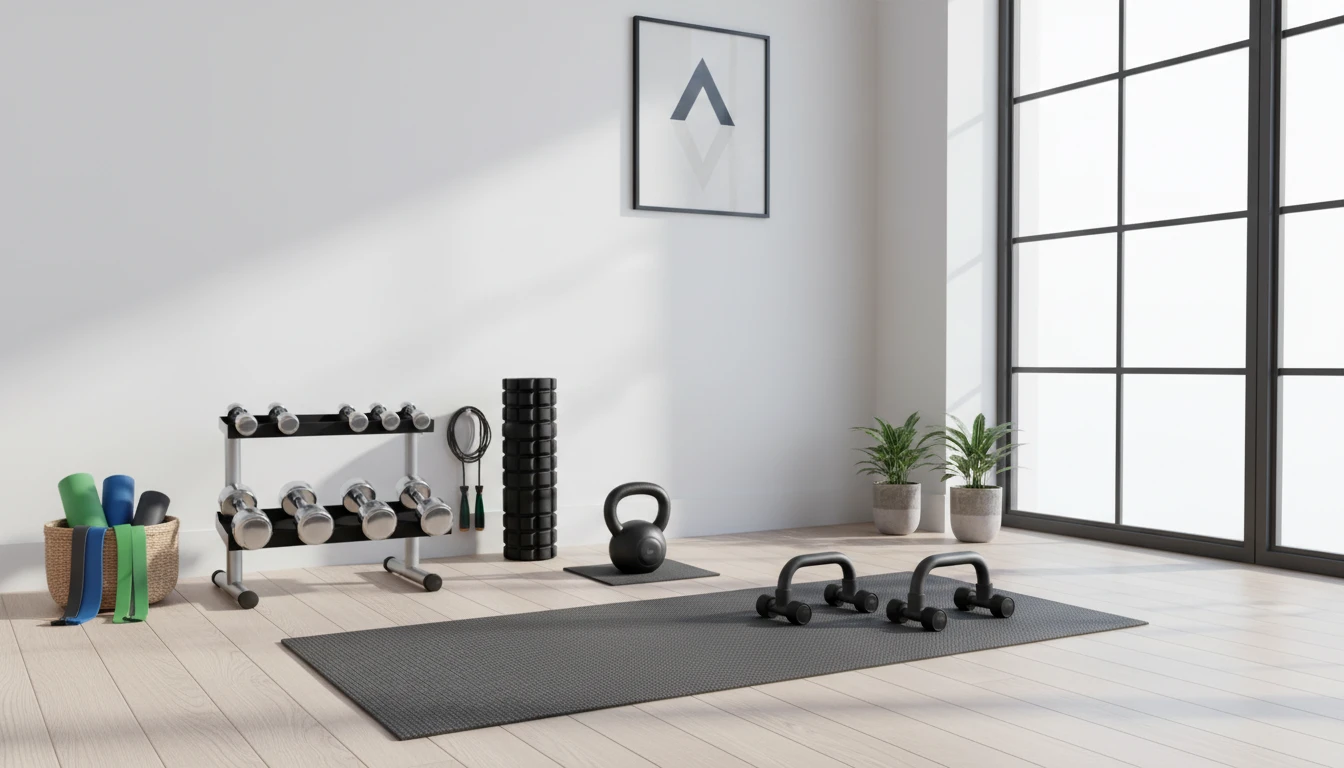
- Adjustable Dumbbells – The most versatile strength training tool, replacing an entire rack of weights while occupying minimal space
- Resistance Bands Set – Portable, affordable, and effective for strength training, mobility work, and rehabilitation exercises
- Yoga Mat – A non-negotiable foundation for floor work, stretching, and bodyweight exercises that protects joints and prevents slipping
- Kettlebell (16-24kg) – Enables dynamic movements that combine strength and cardio in one efficient package
- Pull-Up Bar – Doorway-mounted options provide mobility maintenance between sessions, Exercise Ball – Adds core instability training, resistance tools, with the remaining portion dedicated to recovery, and cardio accessories. This distribution ensures you’re covered for comprehensive training while maintaining flexibility as your fitness goals evolve and specialized equipment becomes necessary.
What Are the Must-Have Pieces of Fitness Equipment for Home Workouts?
The foundation of any functional home gym starts with three core categories: resistance, cardio, and flexibility tools. What typically happens is that people overcomplicate their initial purchases, but the essentials are surprisingly straightforward.
Start with adjustable dumbbells—they replace an entire rack while occupying minimal floor space. Add a quality yoga mat that provides adequate cushioning for floor work and stretching routines. A resistance band set fills the gap between bodyweight exercises and heavier loads, offering progressive difficulty without storage headaches.
For cardio, one versatile piece beats multiple specialized machines. A jump rope delivers intense conditioning in any corner of your home, while a kettlebell serves double duty for both strength and cardiovascular training through swing variations.
The truth about “must-have” equipment? Your specific goals determine priorities. A runner needs different basics than someone focused on strength building. However, these foundational pieces create enough training variety to support most fitness objectives while maintaining the flexibility to add specialized equipment as your routine evolves. The key is establishing a baseline that prevents workout monotony without creating clutter.
Which Everyday Items Can Be Used as Gym Equipment at Home?
Your home is already filled with surprisingly effective fitness tools that cost nothing extra. A sturdy chair becomes your workout bench for tricep dips, step-ups, and incline push-ups. Filled water bottles or laundry detergent jugs work as adjustable weights—start light and progress as you build strength.
Towels create resistance for exercises and serve as sliders on hardwood floors for mountain climbers and hamstring curls. A backpack loaded with books transforms into a weighted vest for squats and lunges. Stairs deliver intense cardio and leg strengthening, while your couch supports modified planks and decline push-ups.
The creativity here matters more than the equipment. What typically happens is that these improvised tools help beginners build consistency without the pressure of expensive purchases. A heavy textbook under each hand adds challenge to glute bridges, while a broom handle becomes a mobility tool for shoulder stretches.
Key takeaway: Building your home fitness routine doesn’t require waiting for the perfect equipment. Start with what you have, establish the habit, then strategically add specialized tools as your training evolves and your commitment solidifies.