Understanding Smart Toilets with Bidet Functionality
The smart toilet represents a convergence of bathroom fixture and technology that’s reshaping personal hygiene across American homes. Unlike traditional toilets, these integrated systems combine automated flushing, heated seats, and built-in bidet functionality into a single, streamlined unit. The global smart toilet market is experiencing rapid expansion, driven by growing awareness of hygiene benefits and advances in home automation technology.
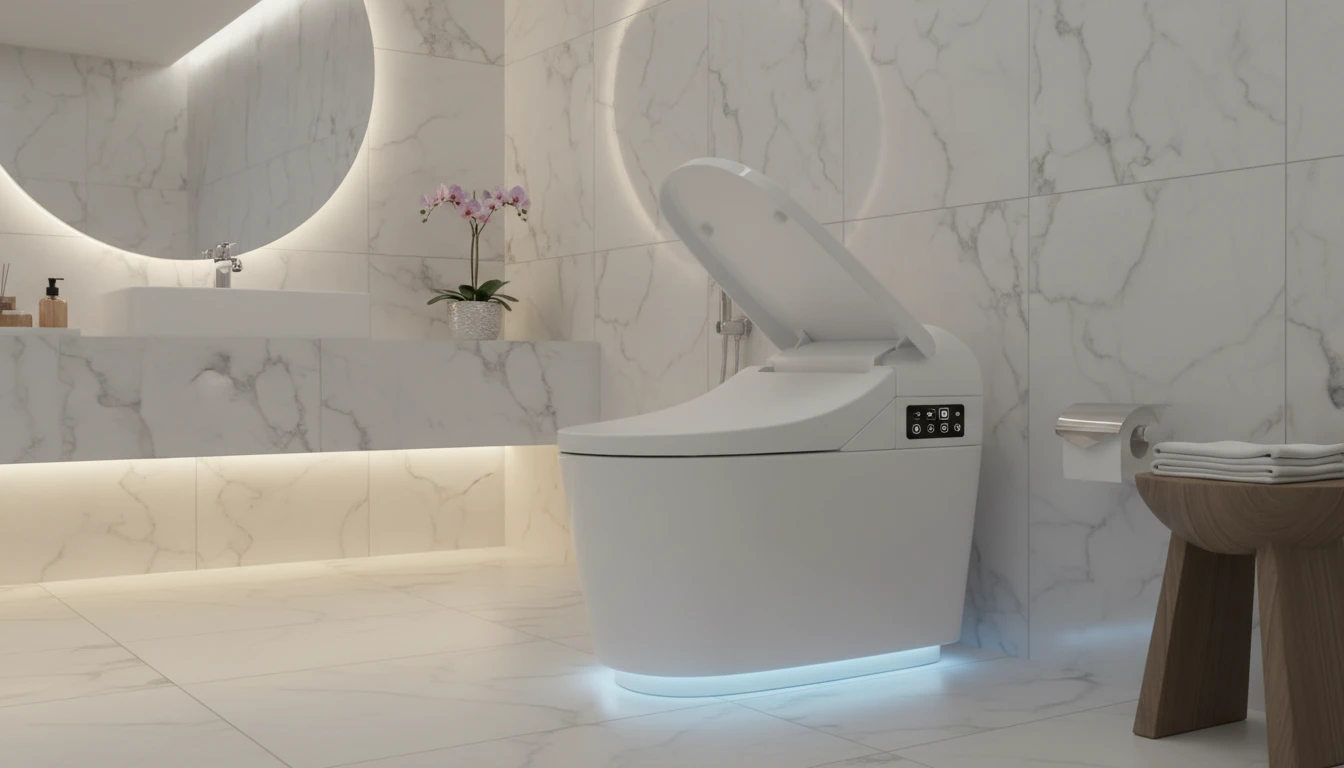
At its core, a smart toilet with bidet functionality replaces the conventional toilet-paper-only approach with water-based cleansing—activated by sensors or touch controls. Most models feature adjustable water pressure, temperature settings, and positioning options that accommodate different users and preferences. The technology extends beyond basic washing: premium units incorporate warm air dryers, deodorizers, night lights, and even health monitoring sensors that analyze waste for potential medical insights.
What distinguishes these fixtures from standalone bidet attachments is their integrated design. Everything operates from a single control panel or smartphone app, eliminating the need for separate installations or awkward positioning. This integration also means consistent aesthetics—no visible hoses or bolt-on components disrupting your bathroom’s visual flow.
Why Consider a Smart Toilet with Bidet?
The bidet toilet market is experiencing remarkable growth, with projections indicating a surge to $21.3 billion by 2034. This expansion isn’t driven by novelty—it’s fueled by genuine advantages that resonate with modern homeowners.
Water efficiency stands out as a compelling factor. A single bidet toilet can eliminate the need for approximately 57 sheets of toilet paper per week, translating to significant environmental and cost savings over the fixture’s lifespan. For households concerned about rising utility costs, this reduction matters.
Health considerations drive many purchasing decisions. Unlike dry paper, water cleansing offers a more thorough clean that can benefit those with mobility limitations, hemorrhoids, or post-surgical recovery needs. The gentle approach proves particularly valuable for aging-in-place modifications.
However, the investment demands careful consideration. Initial costs range from $1,000 to $10,000 depending on features, and installation may require electrical upgrades. Market research indicates that North America’s adoption still lags behind Asian markets, suggesting a learning curve exists. Not every bathroom supports these fixtures—older plumbing or limited space can complicate installation, making professional assessment essential before committing.
Key Features of Smart Toilets with Bidets
Today’s smart bidet systems pack sophisticated features that transform ordinary bathroom routines into personalized wellness experiences. The technology extends far beyond basic water cleansing—these fixtures integrate sensors, heating elements, and connectivity that respond to individual preferences.
Core functionality includes adjustable water temperature and pressure controls, allowing users to customize their cleansing experience from gentle to thorough. Most models feature heated seats with temperature presets, eliminating the shock of cold porcelain during winter months. According to market analysis, warm air dryers represent a standard inclusion, reducing or eliminating toilet paper dependency entirely.
Advanced capabilities separate premium models from basic offerings. Self-cleaning nozzles use UV light or electrolyzed water to maintain hygiene between uses. Automatic deodorizers neutralize bathroom odors through carbon filters or ionization technology. Motion-activated lids open as you approach and close after you leave—a hands-free convenience that enhances both accessibility and cleanliness.
The most sophisticated systems incorporate night lights, integrated speakers, and smartphone connectivity through companion apps. Users can save personalized profiles, adjust settings remotely, and even monitor water usage patterns. However, these premium features typically command higher price points, making it essential to identify which capabilities genuinely enhance your daily routine versus novelty additions.
Comparing Smart Toilets and Bidet Seats
Choosing between a complete bidet smart toilet and an add-on bidet seat depends on your budget, bathroom layout, and feature priorities. Both options deliver superior hygiene compared to traditional toilets, but they differ significantly in installation complexity and cost.
Bidet seats attach to existing toilets and typically range from $200 to $1,000, requiring only a nearby electrical outlet for heated features. They’re ideal for renters or homeowners testing bidet functionality before committing to a full upgrade. However, these seats often lack advanced features like automatic lid opening, integrated air dryers, or self-cleaning nozzles.
Complete smart toilet systems integrate all bidet functions directly into the bowl, eliminating gaps between components and creating a seamless aesthetic. The bidet seats market has shown steady growth, with premium models offering touchless operation, customizable spray patterns, and heated seats as standard features.
Installation represents the biggest decision factor: bidet seats install in minutes, while smart toilets require professional plumbing modifications. What typically happens is that homeowners renovating their bathrooms opt for full systems, while those seeking immediate upgrades choose retrofit seats that preserve existing fixtures.
Industry Examples: Top Smart Toilets and Bidet Brands
The smart toilets with bidet market features several manufacturers driving innovation in different price segments. Japanese companies like TOTO and Kohler have established premium positioning with advanced features and decades of refinement. TOTO’s Neorest series integrates auto-open lids, UV sanitization, and heated seats, while Kohler’s Veil model emphasizes sleek design alongside bidet functionality.
Mid-range competitors like Bio Bidet and WOODBRIDGE offer compelling feature sets at accessible price points, typically including adjustable water pressure, warm air drying, and remote controls. According to bidets market analysis, increasing consumer awareness of hygiene benefits continues expanding the addressable market beyond early adopters.
European manufacturers like Duravit and Villeroy & Boch bring design-forward approaches that appeal to aesthetically-conscious consumers. These brands often emphasize water efficiency and sustainability messaging alongside comfort features. The competitive landscape remains fragmented, with regional preferences influencing which brands dominate specific markets—American buyers gravitate toward feature-rich options, while Asian markets prioritize compact designs for smaller bathrooms.
Installation and Maintenance Considerations
Installing a bidet toilet seat typically requires minimal plumbing expertise—most add-on seats connect to existing water lines with included adapters and can be installed in under an hour. However, complete smart toilet units demand professional installation, particularly models with integrated dryers and heated seats that need dedicated electrical circuits. In practice, homeowners often underestimate space requirements; measuring rough-in distances (typically 12 inches from wall to drain) prevents costly returns.
Maintenance proves straightforward for most systems. Nozzles require monthly cleaning with manufacturer-approved solutions to prevent mineral buildup, while water filters need replacement every six months depending on water hardness. One practical approach involves scheduling maintenance during regular bathroom cleaning routines. Models with self-cleaning nozzles reduce hands-on maintenance, though they still benefit from periodic manual inspection. Keep in mind that warranty coverage often depends on documented maintenance—skipping filter changes may void protection on components costing hundreds to replace.
Limitations and Considerations
While an intelligent toilet delivers impressive convenience, potential buyers should weigh several practical constraints before committing. The most significant barrier remains upfront cost—premium models with comprehensive features can exceed $5,000, making them a substantial investment compared to traditional fixtures. According to market analysis, price sensitivity continues to limit adoption rates in certain regions.
Technical dependencies present another challenge. These systems require reliable electrical power and adequate water pressure to function properly. A power outage renders electronic features unusable, though basic toilet functionality typically remains intact. Older homes may need electrical upgrades to support installation safely.
However, complexity doesn’t necessarily mean frequent breakdowns. Modern units generally prove durable, though specialized repairs can cost more than conventional plumbing fixes. Some users also report adjustment periods learning control interfaces, particularly with advanced app-connected models that offer dozens of customization options.
Space constraints matter too—compact bathrooms may struggle to accommodate larger integrated units, though slim bidet seats work in tighter quarters. These practical considerations help determine whether the technology aligns with your specific bathroom configuration and household needs.
Are smart bidet toilets worth it?
Whether a smart toilet with bidet justifies its premium price tag ultimately depends on your household’s priorities and budget constraints. For households with elderly members, individuals with mobility challenges, or anyone prioritizing hygiene and comfort, the investment typically delivers measurable daily value. Features like automatic flush, heated seats, and hands-free operation reduce physical strain while elevating bathroom cleanliness beyond what traditional fixtures provide.
The financial equation becomes more favorable when considering long-term savings. Reduced toilet paper consumption—often dropping by 75% or more—translates to meaningful annual savings while supporting environmental goals. Additionally, the potential for higher home resale value in markets where luxury bathroom fixtures influence buyer decisions can offset a portion of the initial outlay.
However, buyers operating on strict budgets or living in rental properties may find standalone bidet attachments ($30-$100) deliver sufficient functionality without the complexity or cost of a full smart toilet system. These simpler solutions maintain the core hygiene benefits while avoiding installation complications and ongoing maintenance concerns that accompany advanced electronic models.
Frequently Asked Questions About Smart Toilets with Bidets
How difficult is installation?
Installation complexity varies by model. Some units require professional plumbing modifications, particularly integrated one-piece designs that replace existing toilets entirely. However, many bidet seat attachments can be installed by homeowners in under an hour, requiring only a nearby electrical outlet and basic tools.
Can children and elderly users operate these safely?
Most models include simplified remote control options or preset buttons designed for users with limited mobility or technical confidence. Child-safe modes prevent accidental activation of high-pressure settings, while elderly users benefit from features like warm water, gentle air drying, and heated seats that reduce physical strain.
What happens during power outages?
Smart toilets typically retain basic flushing capability during power failures, though electronic features like heated seats and bidet functions become unavailable. Some premium models include battery backup systems for essential operations, but this varies significantly across brands and price points.
Do smart toilets require special maintenance?
Regular cleaning with non-abrasive cleaners suffices for most models. Nozzle self-cleaning functions reduce manual maintenance, though periodic deep cleaning and filter replacements remain necessary. According to Smart Toilet Market research, manufacturers increasingly design components for easier user servicing to reduce long-term ownership costs.
Key Takeaways
Smart toilets with bidets represent a significant upgrade that combines hygiene, comfort, and sustainability in one fixture. Expect to invest $500-$7,000 depending on features, with mid-range models offering the best balance of functionality and value. The technology delivers measurable benefits: reduced toilet paper consumption by up to 75%, improved personal hygiene through customizable water cleansing, and enhanced accessibility for those with mobility challenges.
Installation typically requires GFCI electrical access and may need professional plumbing modifications, particularly for integrated models. However, the ongoing market growth reflects increasing consumer satisfaction with these fixtures. Key features worth prioritizing include adjustable water temperature and pressure, heated seats, and user presets for households with multiple people.
While smart bidets aren’t essential for everyone, they make particular sense for eco-conscious households, those prioritizing hygiene innovations, or individuals with specific health needs. The question becomes less about whether the technology works—it demonstrably does—and more about whether these specific benefits align with your household’s values and budget priorities.
Are smart bidet toilets worth it?
The value proposition depends heavily on your priorities and budget. Smart bidet toilets deliver measurable returns in three key areas: reduced toilet paper consumption (saving $100-150 annually per person), lower environmental impact, and enhanced personal hygiene that can reduce healthcare costs related to bathroom-related issues.
The global smart bathroom market is projected to reach $11.75 billion by 2034, reflecting growing consumer acceptance of these fixtures as permanent home upgrades rather than luxury novelties. Strong resale value in modernized bathrooms further justifies the investment for homeowners.
However, the return on investment timeline matters. Budget models around $500 pay for themselves within 3-4 years through paper savings alone, while premium $5,000+ units may take 15+ years to break even purely on consumables. The intangible benefits—improved comfort, accessibility features for aging-in-place, and reduced plumbing maintenance—often tip the scale for buyers who can afford the upfront cost.
Consider your household size and usage patterns carefully. Larger families see faster payback periods, while single occupants might struggle to justify premium models based solely on financial metrics. The upcoming section explores potential drawbacks that could impact your decision.
What is the downside of a bidet toilet?
Despite their growing popularity, smart bidet toilets come with legitimate drawbacks worth considering. The upfront investment remains the primary barrier, with quality units starting around $500 and premium models exceeding $7,000—substantially more than conventional toilets that often cost under $200.
Installation complexity presents another challenge. Unlike standard toilets requiring only water supply connections, bidet toilets need dedicated electrical outlets near the fixture. Many bathrooms lack these outlets, adding $200-$500 in electrical work to the total cost. Older homes may require upgraded wiring to handle the electrical load safely.
Repair and maintenance concerns escalate with technological complexity. When a basic toilet breaks, replacement parts are universal and inexpensive. Smart bidet toilets contain proprietary components—heated seats, spray mechanisms, dryers, and electronic controls—that can fail independently. Finding qualified technicians familiar with specific models may prove difficult, and out-of-warranty repairs can cost hundreds of dollars.
Water and electricity consumption, while generally modest, does increase household utility usage. The continuous power draw for heated seats and instant-heat water systems adds to monthly bills. For environmentally conscious users, this creates a trade-off between reduced toilet paper usage and increased energy consumption.
Bidet Seat vs. Bidet Toilet – Which One Should I Get?
The choice between a bidet seat and a complete smart bidet toilet hinges on three factors: budget constraints, existing bathroom infrastructure, and desired feature depth. Bidet seats offer remarkable value for renters or those hesitant about major bathroom renovations—installation takes under an hour, costs typically range from $200 to $1,000, and they preserve your existing toilet. However, they compromise on aesthetics with visible plumbing connections and lack integrated features like automatic flushing or tankless designs.
Full smart bidet toilets eliminate these compromises through seamless design integration and comprehensive automation. The streamlined appearance, self-cleaning capabilities, and tankless water heating justify the premium for homeowners planning long-term residence. Yet the $1,500-$5,000 price gap, professional installation requirements, and permanence make them unsuitable for temporary living situations or uncertain bathroom layouts.
For most households, bidet seats provide 80% of the hygiene benefits at 20% of the cost—making them the practical starting point before committing to a full smart toilet replacement.
Best Bidet Toilet for $2500?
The $2500 price point represents the sweet spot for premium smart bidet toilets—high enough to access advanced features, yet restrained enough to avoid paying for diminishing returns. At this budget level, you’re targeting models that deliver heated seats, customizable spray patterns, air drying, automatic deodorization, and soft-close lids without the markup of ultra-luxury brands.
What typically separates $2500 models from their $1500 counterparts? The difference often lies in build quality, ceramic durability, and feature refinement rather than feature quantity. You’ll find stainless steel nozzles instead of plastic, more precise temperature controls, and quieter operation. However, you’re still below the threshold where you’d encounter motion-activated lids, UV sterilization, or premium remote controls.
The practical approach at this price point involves comparing warranty lengths and checking whether installation hardware is included. Many manufacturers bundle essential components at higher price tiers, which can offset the apparent cost difference. A model priced at $2400 with included mounting hardware and extended warranty often delivers better value than a $2200 unit requiring separate purchases. This consideration becomes particularly relevant as the smart toilet market continues expanding, with manufacturers increasingly competing on total ownership value rather than initial sticker price.
What are the key benefits of installing a smart bidet toilet at home?
The compelling advantages of smart bidet toilets extend well beyond mere novelty. Enhanced hygiene stands paramount—water cleaning proves significantly more effective than paper alone, reducing bacteria transfer and improving personal cleanliness. Many users report feeling noticeably fresher throughout the day.
Long-term cost savings accumulate steadily. While toilet paper expenses seem minor weekly, they compound to $150-$200 annually per person. A smart bidet toilet eliminates this recurring expense, typically paying for itself within 3-5 years while simultaneously reducing environmental impact.
Accessibility improvements benefit users with limited mobility, arthritis, or post-surgical recovery needs. Automated features—particularly air drying and hands-free operation—restore independence for those who might otherwise require assistance. Increased home value represents another tangible benefit, as smart bathroom fixtures appeal to health-conscious buyers and signal modern, well-maintained properties.
The convergence of hygiene, economy, and convenience creates a compelling ownership proposition that transcends initial sticker shock.
Are smart bidet toilets worth it?
The investment question ultimately hinges on your priorities and bathroom usage patterns. For households prioritizing superior hygiene, accessibility needs, or environmental sustainability, smart bidet toilets deliver measurable returns through reduced toilet paper consumption and enhanced cleanliness. The market momentum supports this value proposition—global smart toilet demand is projected to reach $19 billion by 2030, reflecting growing consumer recognition of these benefits.
Key considerations for value assessment:
- Daily usage frequency justifies higher upfront costs
- Health conditions or mobility limitations amplify benefits
- Environmental impact aligns with sustainability goals
- Long-term toilet paper savings offset initial investment
- Modern bathroom aesthetics enhance home resale value
The “worth it” calculation becomes clearer when viewing smart bidet toilets as long-term health and comfort investments rather than luxury purchases. For families using the bathroom multiple times daily, the cumulative hygiene improvements and convenience gains compound over years of ownership. However, budget-conscious buyers may find comparable core functionality in mid-range models without premium automation features—the $2500 price point discussed earlier often represents the optimal balance between comprehensive features and reasonable cost.
Smart bathroom technology is becoming an important part of modern homes. Devices like smart toilets, automatic faucets, and intelligent mirrors are transforming daily routines. If you’re interested in upgrading your house with innovative devices, explore more ideas in our smart home guides.